Math-Students will be given more complex math situations for area and perimeter. They will need to use their previous knowledge of how to solve for area and perimeter and in some instances be able to do both operations within the given situation.
Science- We are working on our sun and stars unit. Check out the link to the video below. It is a quick representation of the size of the moon, Earth, other planets, the sun, and other major stars in the sky. We will learn the reason behind the naming of constellations. Students will create and name their own constellation.
https://www.youtube.com/watch?v=HEheh1BH34Q
Monday, March 2, 2020

Wednesday, February 26, 2020
Week at a Glance 2/24
Math-We have started a new unit on quadrilaterals. Students are sorting and classifying shapes based on whether they have parallel lines, right angles, and equal sides. Later in the week, we will review perimeter.

Science- We are working on our sun and stars unit. Check out the link to the video below. It is a quick representation of the size of the moon, Earth, other planets, the sun, and other major stars in the sky. We will learn the reason behind the naming of constellations. Students will create and name their own constellation.
https://www.youtube.com/watch?v=HEheh1BH34Q

https://www.youtube.com/watch?v=HEheh1BH34Q
Tuesday, February 18, 2020
Week at a Glance 2/10 and 2/17
Math-We will start a new unit on graphing and data. Students will learn how to create scaled bar graphs when given data. They will also answer questions to interpret the data.

Science- We are continuing to discuss energy, with a focus on light energy and radiant energy. Students are learning that light reflects, refracts, or absorbs. We will use mirrors, lasers, and gummy bears in class to show examples of each.

Science- We are continuing to discuss energy, with a focus on light energy and radiant energy. Students are learning that light reflects, refracts, or absorbs. We will use mirrors, lasers, and gummy bears in class to show examples of each.
Sunday, January 26, 2020
Week at a Glance 1/27 and 2/3
Math-We will work on comparing fractions with unlike denominators. I am encouraging students to draw identical stacked number lines to compare. The fraction closer to the next whole is larger.

We will also start to discuss equivalent fractions.

Science- We are continuing to discuss energy, with a focus on light energy and radiant energy. Students are learning that light reflects, refracts, or absorbs. We will use mirrors, lasers, and gummy bears in class to show examples of each.
We will also start to discuss equivalent fractions.
Science- We are continuing to discuss energy, with a focus on light energy and radiant energy. Students are learning that light reflects, refracts, or absorbs. We will use mirrors, lasers, and gummy bears in class to show examples of each.
Friday, January 10, 2020
Week at a Glance 1/13 and 1/20
Math-I will introduce fractions on a number line this week. See the chart below on the steps to create a number line between one whole. There is also a link to a video that we will be using in class to help students understand the process.

https://www.youtube.com/watch?v=SZaXtOHNh6s
Science- We are continuing to discuss energy, with a focus on light energy and radiant energy. Students are learning that light reflects, refracts, or absorbs. We will use mirrors, lasers, and gummy bears in class to show examples of each.
https://www.youtube.com/watch?v=SZaXtOHNh6s
Science- We are continuing to discuss energy, with a focus on light energy and radiant energy. Students are learning that light reflects, refracts, or absorbs. We will use mirrors, lasers, and gummy bears in class to show examples of each.
Monday, January 6, 2020
Week at a Glance 1/6
Math- We are continuing our unit on fractions. I will introduce comparing fractions. At first I am teaching them to draw two identical stacked rectangles, partition the rectangle, and then shade the fractional part. This helps them to visualize the size. (See the example below.)
Eventually, they will be able to look at the fraction and reason that the more you partition a fraction the smaller the pieces get. They will no longer need to draw the model once they have that understanding.

Science-We are continuing our unit on forms of energy. Students will design a robot that uses all 5 forms of energy and sketch what it will look like. This has been a lot of fun for students in the past.

Eventually, they will be able to look at the fraction and reason that the more you partition a fraction the smaller the pieces get. They will no longer need to draw the model once they have that understanding.
Science-We are continuing our unit on forms of energy. Students will design a robot that uses all 5 forms of energy and sketch what it will look like. This has been a lot of fun for students in the past.
Friday, December 13, 2019
Week at a Glance 12/9 and 12/16
Math-We will start our new unit on fractions this week. Students will learn how to notate fractions as the numerator (number shaded) over the denominator (total parts of the whole). We are discussing the idea that the more times you cut or share a whole, the smaller the part.

Science-We will start our study on the five basic forms of energy-mechanical, electrical, light, thermal, and sound. Students will brainstorm examples and we will go on a scavenger hunt around the school looking for them too.
Science-We will start our study on the five basic forms of energy-mechanical, electrical, light, thermal, and sound. Students will brainstorm examples and we will go on a scavenger hunt around the school looking for them too.
Tuesday, November 19, 2019
Week at a Glance 11/18, 11/25, 12/2
Math-We are starting our unit on area. Students will relate what they have learned from arrays and multiplication to solving the area of given shapes. We will also be tying in measuring using centimeters and inches during this unit as well when they draw their own shape and find the area.

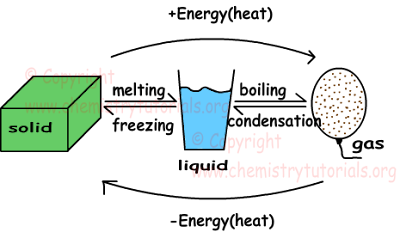
Science-We will review the states of matter (solid, liquid, gas). We are discussing how matter changes from different states. See the image below for vocabulary being used in class.

Friday, November 8, 2019
Week at a Glance 11/11
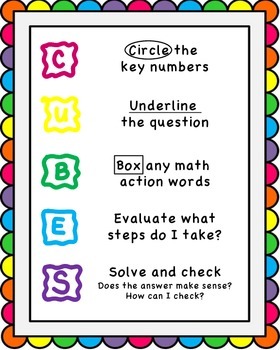
Math- We are finishing our 2nd unit on multiplication and division this week. Students will apply what they have learned from our unit to solve multi-step problems, involving all operations-addition, subtraction, multiplication, or division. In the past, this has proven to be very tricky. I encourage students to use the CUBES method below as a step by step guide to solving the problems. If the students see more than two numbers in a story problem, they need to ask themselves are all these numbers important to solving and then they have to visualize how to use all the numbers to arrive at a solution.
Science-We will review the states of matter (solid, liquid, gas). We are discussing how matter changes from different states. See the image below for vocabulary being used in class.
Monday, October 21, 2019
Week at a Glance 10/21 and 10/28
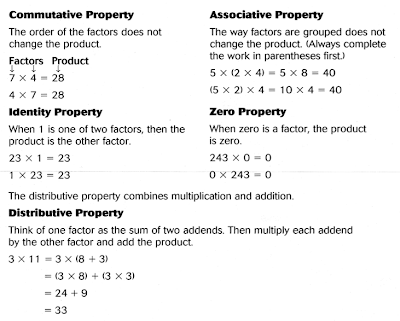
Math-We will go back to multiplication this week, focusing more on the factors of 6, 7, 8, and 9. These are harder to memorize. Please have your students practicing their skip counting (6, 12, 18, 24, etc.), Xtra Math, and multiplication flash cards. We will be going deeper with the commutative and distributive property of multiplication. See chart.
Science- Students will focus on the properties of matter this week. The will use their senses to observe size, shape, color, hardness, and texture of given objects.

Monday, October 14, 2019
Week at a Glance 10/14
Math- This week our focus is on reviewing addition and subtraction with regrouping, as well as subtracting across zeroes. Students will add with sums up to 1,000 and subtract with a minuend (top number) up to 1,000.

Science- We are starting our unit on matter. Students will focus on the properties of matter this week. The will use their senses to observe size, shape, color, hardness, and texture of given objects.
Friday, October 4, 2019
Week at a Glance 10/7
Math- This week we will start our new standard of rounding to the nearest tens and hundreds. I will have the students draw a vertical number line with endpoints as the two nearest tens or two nearest hundreds. They will determine the midpoint of the number line and plot the number they are rounding on the number line. Any number in the "round up zone" (5 ones/5 tens or above) rounds up, anything below rounds down. See the example below.

Science- We are starting our unit on matter. Students will focus on the properties of matter this week. The will use their senses to observe size, shape, color, hardness, and texture of given objects.
Friday, September 27, 2019
Week at a Glance 9/30
Math- We are working on telling time to the minute. This has been difficult for some students, so any practice at home will be helpful. It could be as simple as randomly asking the time on an analog clock or downloading a basic time app on your phone or tablet. We will be moving into adding and subtracting time beyond an hour this week. See the cute video below to see examples of the strategies we will be using to solve elapsed time problems.
https://www.youtube.com/watch?v=yy0NwS8abQA
Also this week, we will be working on the relative size/amount of a gram, kilogram, milliliter, and liter. Students are learning that 1,000 grams=1 kilogram and 1,000 milliliters= 1 liter. They are using the units of measure in story problems as well. One way to help students at home is to point out these units when you see them on food packaging. This helps make it relevant.

Science- We are still doing introductory lessons in science focused on the processes scientists use, how they communicate their findings, and the tools they use to perform experiments.
https://www.youtube.com/watch?v=yy0NwS8abQA
Also this week, we will be working on the relative size/amount of a gram, kilogram, milliliter, and liter. Students are learning that 1,000 grams=1 kilogram and 1,000 milliliters= 1 liter. They are using the units of measure in story problems as well. One way to help students at home is to point out these units when you see them on food packaging. This helps make it relevant.
Science- We are still doing introductory lessons in science focused on the processes scientists use, how they communicate their findings, and the tools they use to perform experiments.
Monday, September 23, 2019
Week at a Glance 9/23
Math- We are working on telling time to the minute. This has been difficult for some students, so any practice at home will be helpful. It could be as simple as randomly asking the time on an analog clock or downloading a basic time app on your phone or tablet. See the game link below that I found. Students should be successful at the advanced level of this particular game by the time they leave third grade.
http://mrnussbaum.com/clockworks/
Science- We are still doing introductory lessons in science focused on the processes scientists use, how they communicate their findings, and the tools they use to perform experiments.
http://mrnussbaum.com/clockworks/
Science- We are still doing introductory lessons in science focused on the processes scientists use, how they communicate their findings, and the tools they use to perform experiments.
Friday, September 13, 2019
Week at a Glance 9/16
Math- We are finishing our unit on multiplication and division this week. Students will apply what they have learned from our unit to solve multi-step problems, involving all operations-addition, subtraction, multiplication, or division. In the past years, this has proven to be very tricky. I encourage students to use the CUBES method below as a step by step guide to solving the problems. If the students see more than two numbers in a story problem. They need to ask themselves are all these numbers important to solving and then they have to visualize how to use all the numbers to arrive at a solution.
Science- We are still doing introductory lessons in science focused on the processes scientists use, how they communicate their findings, and the tools they use to perform experiments.
Tuesday, September 10, 2019
Week at a Glance 9/9
Math- We are working on multiplying and dividing using the tape diagram. This is a new strategy introduced to the students last week. See the video below to see how it works. Students will also continue working on their multiplication fluency by grouping and skip counting objects.
https://www.youtube.com/watch?v=OlC1UiPn9kQ
Science- We are still doing introductory lessons in science focused on the processes scientists use, how they communicate their findings, and the tools they use to perform experiments.
https://www.youtube.com/watch?v=OlC1UiPn9kQ
Science- We are still doing introductory lessons in science focused on the processes scientists use, how they communicate their findings, and the tools they use to perform experiments.
Monday, August 26, 2019
Week at a Glance 8/26
Math- We are continuing to work on our properties of multiplication. Last week we did the commutative property and this week we are exploring the distributive property. Students are being asked to show multiplication in a couple ways, groups of and arrays.
 Science- We are still doing introductory lessons in science focused on the processes scientists use, how they communicate their findings, and the tools they use to perform experiments.

Wednesday, August 7, 2019
Week at a Glance 8/12 and 8/19
Welcome parents and students! I am excited for a new year and an opportunity to work with your children.
Math- We will be starting the year diving right into multiplication. The first way students will show multiplication is by putting a factor into equal groups. For example: our desks are in four equal groups with 5 in each group, for a total of 20. Daily math homework (M, T, W, Th) will begin the week of August 19th.

Science- We are doing introductory lessons in science focused on the processes scientists use, how they communicate their findings, and the tools they use to perform experiments.
Math- We will be starting the year diving right into multiplication. The first way students will show multiplication is by putting a factor into equal groups. For example: our desks are in four equal groups with 5 in each group, for a total of 20. Daily math homework (M, T, W, Th) will begin the week of August 19th.
Science- We are doing introductory lessons in science focused on the processes scientists use, how they communicate their findings, and the tools they use to perform experiments.
Subscribe to:
Posts (Atom)